
When I sat down with a government official in Nairobi who was head of the department of children’s services in Kenya,
I was surprised by what I heard. I was expecting praise for wanting to build an orphanage to house orphaned children who had been evicted from the private children’s home called St. Francis Integrated School in Karen when it was closed for health violations in the spring of 2007. Instead what I got was a lecture on the importance of creating and maintaining families.
It was the Kenyan government’s policy at the time to encourage placing orphaned children not in institutions where they might receive three meals a day, water, clothing, security and even education, but in home settings within their own villages, in the company of whatever blood relatives they had. The concept was to support the women who supervised these homes by providing the needed food and other supplies to care for the children they were to look after. It made sense to me. Why create an artificial institutional environment that the child would eventually leave only to face the real world without the necessary skills that are learned in a more natural setting? Wouldn’t it be better to keep them in their home villages and give them the same essential requirements of life? The problem, I later learned, was that the support that should have been provided by the government was either never sent or was administered through a network of village chiefs who wielded great power through such financial leverage. The system was plagued by corruption. The impact on the children was devastating and the cycle of poverty and abuse continued.
The approach African Kids In Need has taken to offer
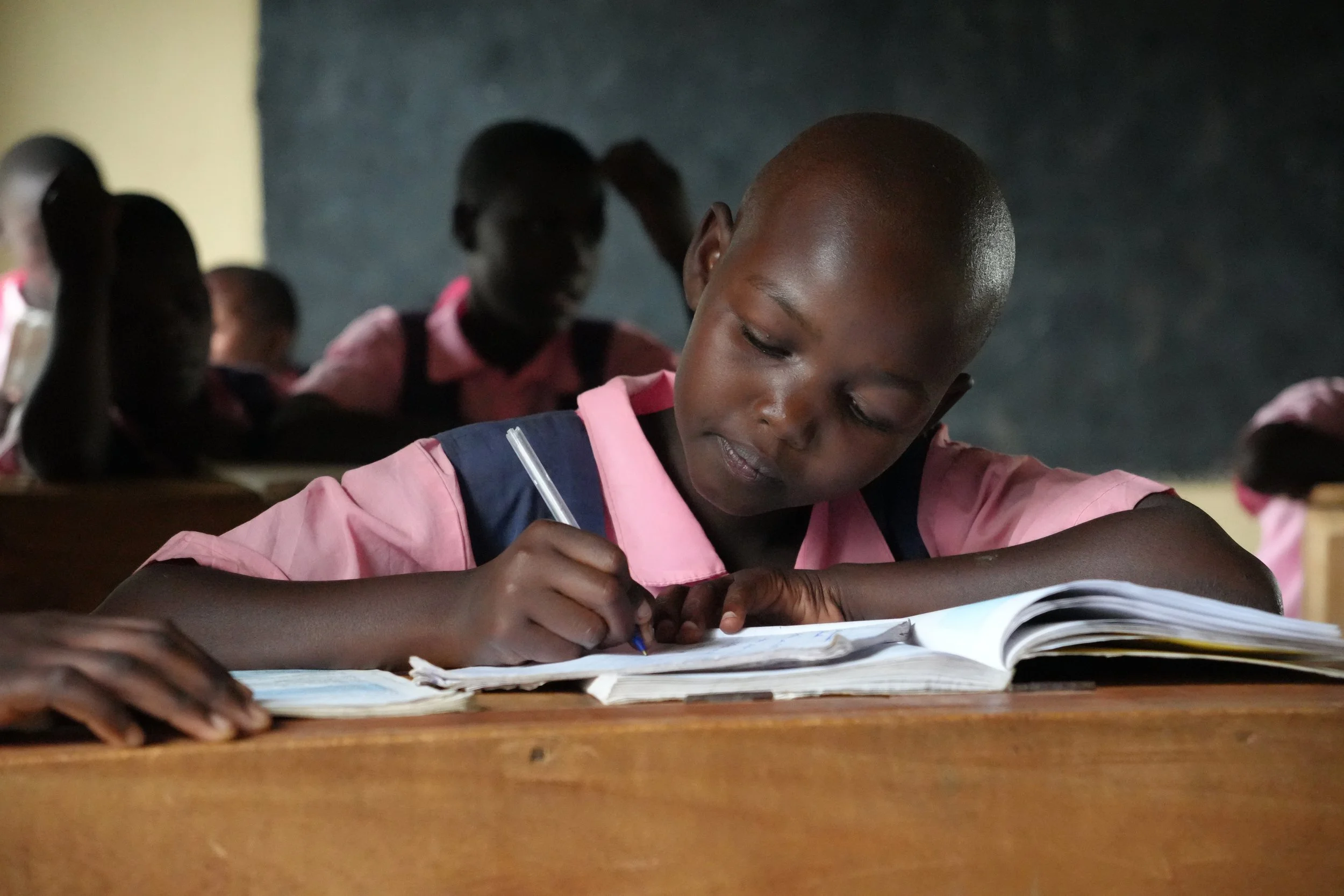
secondary and vocational school education to these orphaned children who we first met at St. Francis in 2005, includes shepherding them through the process of sitting for KCPE (Kenya Certificate of Primary Education) exams and then placing them in boarding schools where they can receive a decent education. The frustration is that we can’t undo the damage that has already been done. Reading essays written by our students when they are asked to provide a life history is a sobering experience. You wonder how they survived to be where they are today. It is a testament to the human spirit. They write about when they were born and when their parents died – some never knew either parent and only have stories from others upon which to create a history for themselves.
They tell about living with an uncle or a grandmother and having little food. Going to school was a luxury. How could they be expected to pass an exam that is supposed to evaluate their knowledge of their entire primary school education when they rarely attended classes. For many of them the road ends there. According to statistics published in a recent article in the Standard Newspaper in Nairobi, about half the 700,000 primary school students who sit for the KCPE exam fail.
“A vast majority of exam candidates…do not go on to secondary school. Child labour, early marriage, informal schooling or dissipation are their lot.” There should be more points at which someone who has failed to make the grade at KCPE …can return to formal education. Locking out at least 300,000 a year consigns half the exam class to a cycle of poverty.”
Published on 31/12/2009
Science teacher gives a lesson in botany at the AKIN school in Kenya
THE AKIN LEARNING CENTER
In order to address this problem, African Kids In Need has established the AKIN Learning Center in Nairobi. It is a small facility that houses ten students in a home school environment. There are two full time Kenyan teachers who offer instruction in English and math and other subjects. The objective is to improve the basic skills of each student and then prepare them to retake the KCPE exam next November. Given this kind of intensive remedial instruction it is our hope that we can get these youngsters back on track to reenter the formal education system at a higher level than would have been possible before. There are many challenges. The children are poorly prepared and have different learning issues.
The teachers are trained, but are young and inexperienced. However, they are passionate about the work and we have formed a mentoring system that includes teachers from the United States and Canada who are advising on curriculum and teaching techniques. The proof of our success will be in the results of the exams next fall. There is no way at this point to predict the outcome, but we do know that the risk of not trying is too great. We will learn from our mistakes as we have from the beginning of the AKIN program in 2007, and we will make adjustments to improve. One thing I know is that the power of the human spirit in these young Kenyan children is worth the investment. For more information about the AKIN Learning Center, visit our website: www.akinlearningcenter.org
Paul Miller is a nationally recognized television director and producer. His directing credits include three seasons on Saturday Night Live, four seasons on In Living Color, ten years directing the Country Music Awards and three years as director of the Tony Awards for which he received a Directors Guild of America Award and an Emmy.
In addition, Paul is partner in a television production company, RickMill
Productions, Inc., which is based in Los Angeles. He and his partner have produced fourteen years of the Comedy Central Presents standup comedy series as well as other specials and series for Comedy Central. He has also produced and directed specials for Showtime (including one starring George Lopez), and HBO (starring Lewis Black), and directed for each of the major broadcast networks.
Paul lives in Los Angeles with his wife, Shelley, and has two children – Tess, who is a student at the School of Visual Arts in New York, and Trevor, who works in investment banking. In addition to his television career, Paul has committed himself as Executive Director of African Kids In Need, a non-profit organization he started in 2007 to help educate orphaned and vulnerable children in Kenya.
[...] his Viewpoint this week, Paul Miller, Executive Director of African Kids in Need, gives us a heartening look at [...]